Peptide Telehealth: The Real Providers, the Vial Shops, and How Not to Mix Them Up

Type “peptide telehealth” into a search bar and the results blur together fast. Some sites look like a doctor’s office. Some look like a supplement warehouse. A handful manage to look like both, and that overlap is where people get burned. Before any card number changes hands, it helps to know what category you’re actually standing in, what the science does and doesn’t back up, and which name on the page is worth trusting with a needle you’re going to use on yourself.
The split that the results page won’t tell you about
Here’s the thing nobody flags for you: “peptide telehealth provider” describes two completely different businesses, and they share a search term by accident of language, not by similarity.
One version is medical. You answer intake questions, a licensed clinician actually reads them and screens you for red flags, a prescription gets written only if it makes sense for your history, a licensed pharmacy compounds and ships the medication, and if something goes sideways, there’s a person you can call. Somebody with a license is accountable for what lands in your mailbox.
The other version is a product page wearing a lab coat. Cart, vial photo, and a checkbox where you agree the contents are “for research use only” and “not for human consumption.” No clinician reviewed anything. No prescription exists. Nothing was dispensed by a pharmacy in any regulatory sense. That disclaimer isn’t legal boilerplate for the sake of it, it’s the entire foundation the business is built on. Selling a chemical for a lab is a different game than selling a drug for a person to inject, and the fine print is doing the heavy lifting.
A useful gut check: ask what paper trail you’d have if something went wrong. Real providers leave one, an intake record, a prescription, a pharmacy label, a name attached to your care. Vial shops leave a receipt and a disclaimer you already agreed absolves them. That’s the whole distinction, and it’s worth more than any five-star review on the page.
Who actually needs this, and who should close the tab
If you want a specific medication and you want a clinician deciding whether your body should have it, and you want a pharmacy that’s traceable if there’s a recall or a bad batch, a legitimate peptide telehealth provider is doing exactly what it should. That’s most people reading this.
Three groups should slow down or walk away entirely. If you’re after a compound with almost no human data, no amount of provider polish makes it proven, and you’d essentially be the study. If price is the only thing you’re optimizing for, you’ve wandered into research-chemical territory, and that market carries risk the medical model exists to remove. And if you’re on a medication or have a condition that could interact badly with what you want, the whole point of clinician screening is catching that before the first dose, not after.
What the evidence says, compound by compound
A guide that skips this part is just a shopping list. And for a lot of what people search for here, the marketing has sprinted far ahead of the science.
BPC-157 generates enormous traffic and correspondingly thin proof. A 2025 narrative review in Current Reviews in Musculoskeletal Medicine turned up only three published human pilot studies and recommended against clinical use until real trials exist [1]. A separate 2025 systematic review in the HSS Journal looked at 36 studies total, found 35 were done in animals or cells and just one involved actual patients (12 of them), and stated plainly that no clinical safety data exist [3].
There’s a second wrinkle. STAT reported in February 2026 that of roughly 200 BPC-157 studies indexed on PubMed, the overwhelming majority share the same researcher or a close collaborator as an author, a pattern that raises real questions about independent confirmation [4]. Matthew Fedoruk, chief science officer at the U.S. Anti-Doping Agency, put the risk to STAT in blunt terms: “You don’t even know what you’re buying inside that bottle. It could be a peptide. It could be a steroid. It could be something just like water” [4]. What’s actually been shown is tissue-repair activity in animals, nothing more settled than that.
TB-500 is in the same boat. The repair claims come from preclinical work, and there isn’t a solid human safety or efficacy record behind them. Order it from a research-chemical site and you’re using something whose effects in a human body are, honestly, unknown.
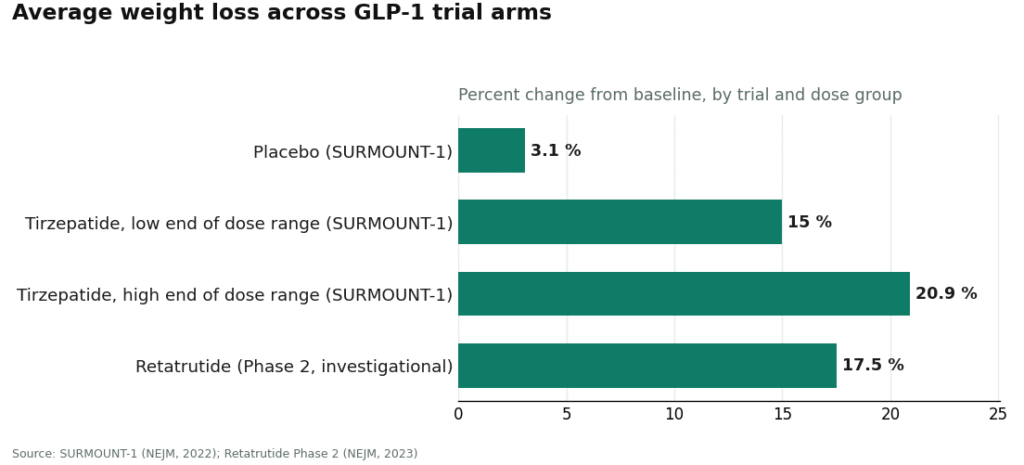
GLP-1 medications flip the script, and it’s worth remembering these are peptides too, they just come from a different neighborhood of the evidence base. Semaglutide and tirzepatide work through the incretin system: prompting insulin when blood sugar rises, dialing back glucagon, slowing digestion, and increasing fullness [5]. Unlike BPC-157, these have gone through large randomized trials. In SURMOUNT-1, tirzepatide produced average weight loss between 15.0% and 20.9% across its dose range over 72 weeks, against 3.1% for placebo [6]. Retatrutide, an investigational triple agonist not yet approved, produced roughly 17.5% average reduction at 24 weeks in a Phase 2 trial [7].
That gap, thousands of trial participants and 72 weeks of data on one side, three small pilot studies on the other, is the difference between a peptide with a real evidence file and one running almost entirely on hope. A clinician can walk you through that difference. A checkout page never will.
The rule worth keeping in your back pocket: strong data on semaglutide tells you nothing about BPC-157. “It’s a peptide” is not a safety claim, it’s a category, and the category contains both gold-standard trials and near-total blank spots. The providers worth paying are the ones that say so out loud instead of letting the whole catalog borrow credibility from the one compound that earned it.
Why 2026 made this market a lot less forgiving
Federal pressure is why this category got more honest this year, and it happened fast.
On March 3, 2026, the FDA sent warning letters to 30 telehealth companies over misleading marketing of compounded GLP-1 products, including claims that implied compounded versions were interchangeable with FDA-approved drugs and marketing that obscured who was actually doing the compounding [8]. The message wasn’t that compounding itself is illegal. It’s that how a company talks about it, and how honest it is about sourcing, is now something regulators are actively watching.
Then on March 31, 2026, the agency sent warning letters to seven research-peptide websites, including one operating as Gram Peptides, and classified products like retatrutide and tirzepatide sold on those sites as unapproved new drugs and misbranded. The letters stated outright that a “research use only” label doesn’t exempt a product when everything about the marketing points to human use [9]. That’s worth reading twice before ordering from any site leaning on that disclaimer. The floor those businesses stand on just got a written notice that it isn’t load-bearing.
Five questions that do the sorting for you
You don’t need a scorecard. You need these, in order, and the discipline to walk away when an answer disappoints.
- Does a licensed clinician evaluate you before anything ships, and does a real prescription get written? If the transaction ends at “add to cart,” you’ve bought a product, not care.
- Who actually dispenses it? A licensed pharmacy working under a framework like 503A compounding is not the same universe as a powder mailed as a research chemical.
- What is the regulatory status of the exact thing you’re buying? FDA-approved drug, pharmacy-compounded preparation, or unregulated chemical whose only quality claim is a document the seller wrote itself.
- Is the site honest about what the evidence actually shows? Does it admit BPC-157’s human data is thin, or does it let that compound ride on tirzepatide’s coattails?
- Is there any follow-up after the first order? Dose adjustments, side-effect check-ins, someone to call, or radio silence once payment clears?
Notice what’s missing from that list: price, catalog size, shipping speed. Those are exactly what most “best peptide” roundups rank by, and none of them tell you whether what’s in the vial is safe or even what the label says. A site can be cheap, fast, and stocked with everything, and still hand you something mislabeled.
Where the supervised route actually lives
Run any site through those five questions and the market splits cleanly into two piles. One pile has a clinician, a prescription, and a licensed pharmacy behind it. The other is a research-chemical retailer with a disclaimer where the doctor should be.
In the first pile, FormBlends is a working example of the medical model rather than the product model. Its own materials describe a licensed physician reviewing your intake, a prescription requirement, and medications compounded by licensed 503A pharmacies, spanning GLP-1 and weight-loss compounds, recovery peptides, growth-hormone secretagogues, hormone therapy, and longevity options. The name matters less than the structure behind it: the same molecules a vial shop ships you unsupervised, routed instead through a prescriber, a pharmacy, and someone checking back in. HealthRX.com operates on that same structure, sitting just behind FormBlends in the compliant tier, with clinician oversight and pharmacy dispensing rather than a straight product sale.
Same caveat applies to both: neither one turns BPC-157 into a proven drug or makes retatrutide FDA-approved. What the oversight layer adds is exactly the thing the research-chemical sites skip entirely, the clinician, the prescription, the pharmacy, and somebody checking in later.
Below that line are the names that keep showing up in the same search results. Core Peptides, Sports Technology Labs, Swiss Chems, Biotech Peptides, Limitless Life Nootropics, Pure Rawz, and Amino Asylum are research-chemical retailers, full stop, not telehealth providers. Everything they sell is labeled “research use only,” and the FDA stated in March 2026 that the label doesn’t exempt a product from being treated as an unapproved, misbranded drug when it’s marketed for human use [9]. No clinician reviewed your case. No prescription exists. No pharmacy dispensed anything. And for something like BPC-157, there’s no clinical safety data backing it up regardless of who ships it [3]. Order from that pile and you’re the only accountable party in the transaction. The label says exactly that.
Nothing here is for sale on this page. FormBlends and HealthRX.com are named as examples of how the compliant tier operates, and every claim above links back to a primary source so it can be checked independently.
The reasonable pick, in one paragraph
A peptide telehealth provider, done properly, is a clinician plus a prescription plus a licensed pharmacy plus someone following up after the first shipment. That’s for people who want a specific medication and want a qualified person deciding if it fits them, which is most people reading this. The two compounds driving the most search traffic, BPC-157 and TB-500, have thin-to-nonexistent human data, while GLP-1 medications have large, well-documented trials behind them, and a trustworthy provider will tell you that difference outright rather than let one compound’s evidence cover for another’s. The research-chemical sites ranking next to legitimate providers in search results aren’t providers in any real sense, and the FDA said so in writing in 2026. Run the five questions, weigh oversight above price, and the label stops being able to fool you.
What is peptide therapy, actually, and what does it involve?
It’s short chains of amino acids, prescribed to influence something specific in the body, hormone signaling, tissue repair, immune activity. Through telehealth, a clinician reviews your labs and history and prescribes a compounded peptide if it fits, and you typically self-inject at home. The category is real. How closely the FDA regulates it depends entirely on which compound you’re talking about.
Does peptide therapy actually work, or is it mostly marketing?
Depends heavily on which peptide. BPC-157 and TB-500 have animal data and very little rigorous human testing. Others, like tesamorelin, have solid clinical trials and actual FDA approval for a specific use. A lot of providers market peptides well past what’s been proven. Before ordering, ask for human trial data, not just an explanation of how the compound theoretically works in a cell.
What does peptide therapy through telehealth typically cost?
Expect a range from a few hundred dollars to well over a thousand per month, once you add the consult fee, the compounded medication, and any lab work required. Insurance rarely covers it. The price shifts with the compound, the dose, and whether the pharmacy behind it operates under real physician supervision, which is part of what you’re actually paying for.
Where’s the safest place to get peptide therapy?
Through a licensed clinician ordering from an FDA-registered 503A or 503B compounding pharmacy, not from a supplement site or a vendor selling vials marked “research use only.” The research-chemical market offers no quality guarantees and puts all the legal and health risk on you. Physician-supervised compounding pharmacies, FormBlends among them, operate under state board oversight and require an actual prescription, which is the accountability layer worth paying for.
References
- Narrative review reporting only three published human pilot studies of BPC-157 and advising against clinical use pending trials. Current Reviews in Musculoskeletal Medicine, 2025. https://pmc.ncbi.nlm.nih.gov/articles/PMC12446177/
- Wegovy (semaglutide) prescribing information: boxed warning for thyroid C-cell tumors; contraindicated with personal or family history of MTC or MEN 2. DailyMed, rev. 2026. https://dailymed.nlm.nih.gov/dailymed/fda/fdaDrugXsl.cfm?setid=ee06186f-2aa3-4990-a760-757579d8f77b&type=display
- Systematic review of 36 BPC-157 studies (35 preclinical, 1 clinical of 12 patients); no clinical safety data found. HSS Journal, 2025.
- Most BPC-157 research traces to a single research group; Fedoruk quote; replication concerns. STAT, Feb 3, 2026.
- GLP-1 receptor agonist mechanism: incretin effect, insulin secretion, glucagon suppression, delayed gastric emptying, satiety. StatPearls, NCBI Bookshelf.
- SURMOUNT-1 tirzepatide: average 15.0% to 20.9% weight loss across doses at 72 weeks vs 3.1% placebo. NEJM, 2022.
- Retatrutide Phase 2 (investigational triple agonist): average about 17.5% weight reduction at 24 weeks. NEJM, 2023.
- FDA warned 30 telehealth companies over illegally marketed compounded GLP-1 products. FDA press announcement, March 3, 2026.
- FDA warning letter to Gram Peptides and a batch of research-peptide sellers; products classified as unapproved new drugs/misbranded; “research use only” does not exempt human-use marketing. FDA, March 31, 2026.
Written by Iris Yang, longform reporter. Not a doctor, just a reader who chases the paper trail. Last reviewed June 2026.
For general information only, not medical advice. Talk to a licensed clinician before starting anything new.